

“The Keeper in the Garden”
The house had been empty for decades – at least, that’s what the neighbours believed. And yet, ivy never dared to climb the stone walls, no glass lay shattered, and the roses in the south garden bloomed every year without fail. Some called it cursed, others said it was blessed. But for me, it was merely inherited.
My grandmother left it to me in her will: “To Elena – the keeper of the key and the truth.”
No one could tell me what truth she meant. The solicitor offered a shrug, and my mother pursed her lips the way she always did when she disapproved of things beyond her control.
It was early spring when I arrived – that kind of brittle warmth that tricks you into thinking winter has truly gone. The estate was surrounded by dense woodland, a tangle of yew and ash and elder. I parked the car and stood before the house, half-expecting it to vanish the moment I blinked.
Inside, the air smelt of thyme and dust. A grand staircase greeted me, curving upwards into dimness. The furniture was still there – draped in covers like ghosts waiting to be remembered. A diary lay open on the piano. The last entry read: He’s still here. Watching. I think he always will be.
I should have left then.
That first night, I dreamt of the garden. Not as it was, but alive – wild and radiant, with flowers that breathed and vines that whispered. And in its centre stood a man. His face was hidden, but I knew he watched me.
I awoke at dawn and stepped outside. The garden called to me. It wasn’t overgrown as one might expect, but perfectly kept, though I’d seen no gardener. The gates were locked, yet somehow I stood within it, barefoot on dew-touched grass.
A circular pattern had been etched into the soil at the heart of the garden – faint, ancient, purposeful. I knelt beside it and touched the centre.
The air changed.
The sunlight dimmed, though no cloud passed. I felt watched. Not malevolently – not quite – but intently, like prey caught in the gaze of something older than time.
A voice broke the silence.
“You shouldn’t be here yet.”
I turned. The man from my dream stood among the trees – tall, cloaked in green, eyes like stormlight.
“I— Who are you?”
His smile was sad. “The same as I’ve always been. The one your grandmother never told you about.”
“I don’t understand.”
“No. But you will.”
He disappeared as suddenly as he’d come.
Over the next days, I searched the house for answers. In the attic, behind a crumbling chest of drawers, I found a letter addressed to me in my grandmother’s hand.
“Elena, if you’re reading this, then the garden has already called you. There is a keeper bound to this place – a soul neither dead nor truly alive. He has protected it since long before your time, and now he cannot leave. My duty was to guard the secret and ensure his prison remained intact. Now, that task falls to you. I’m sorry.”
I wept. Not for the burden passed to me, but for the woman I thought I knew.
On the seventh night, I returned to the garden. The circle pulsed faintly with light, and he was there again, waiting.
“Why are you trapped?”
“I broke a vow,” he said simply. “Long ago. I let someone die who should have lived.”
“Then why guard the garden?”
“It is my penance. This land thrives because of the magic sealed here. If I leave… it will fade.”
“And what happens to me?”
“You stay. Or you leave. But know this – the garden chooses. And once chosen, you are marked.”
A chill passed through me. I felt it in my bones.
That evening, I dreamt of my grandmother. She stood at the garden’s edge, holding the same iron key I now wore around my neck.
“You have a choice,” she whispered. “But only once.”
I woke at midnight, the key heavy against my chest. I dressed, stepped barefoot into the night, and walked to the circle.
He was waiting.
“I don’t want this,” I told him.
“I know.”
“But I can’t let you carry it alone.”
He said nothing, only extended his hand.
I stepped into the circle.
The earth sighed. Light poured up from the soil in shimmering tendrils. My breath caught. His hand closed around mine, and for a moment – just a moment – I saw it all: the forest, the flames, the blood, the choice. The vow he broke. The price paid.
And then it faded.
When I opened my eyes, the circle was empty.
I stood alone – but I wasn’t cold. The air thrummed with something unseen.
He was gone.
And yet, I knew I hadn’t freed him.
I had become him.
Now the garden blooms beneath my gaze.
But it is no longer just a garden – it is a doorway.
A threshold to the realm of dreams.
And I, its keeper, no longer live in waking hours.
I drift through the dreams of others – a whisper in the dark, a warning in the wind.
Sometimes feared.
Sometimes forgotten.
But never free.
My life is no longer my own.
I belong to this place now – to its hush, its hunger, its ancient roots that wind through memory and time.
And my only companion is a ghost of a man – a beautiful echo who may never have truly existed.
Perhaps he was only ever a dream.
And perhaps, now…
so am I.
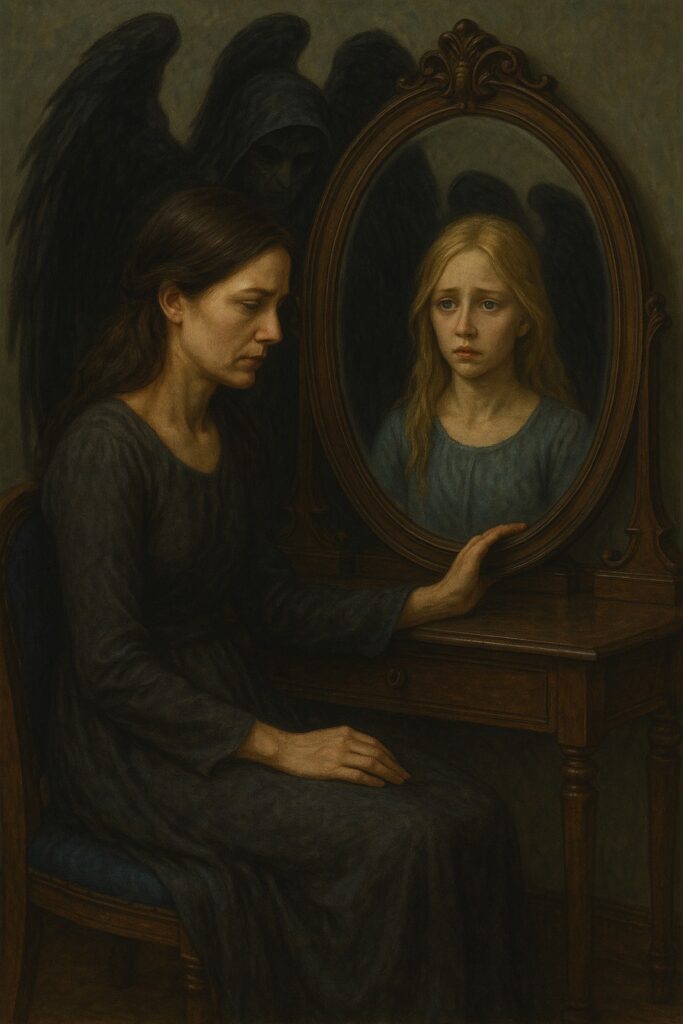
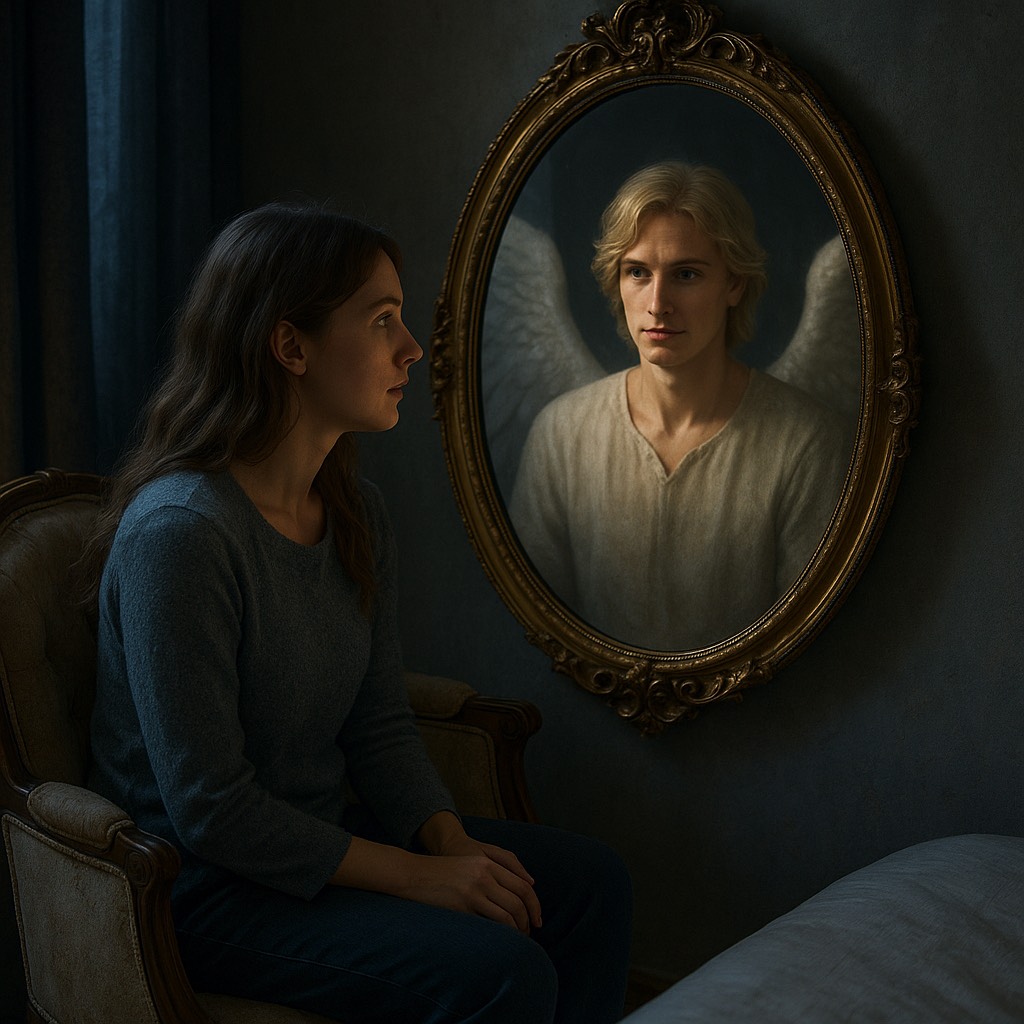
Angel in the mirror
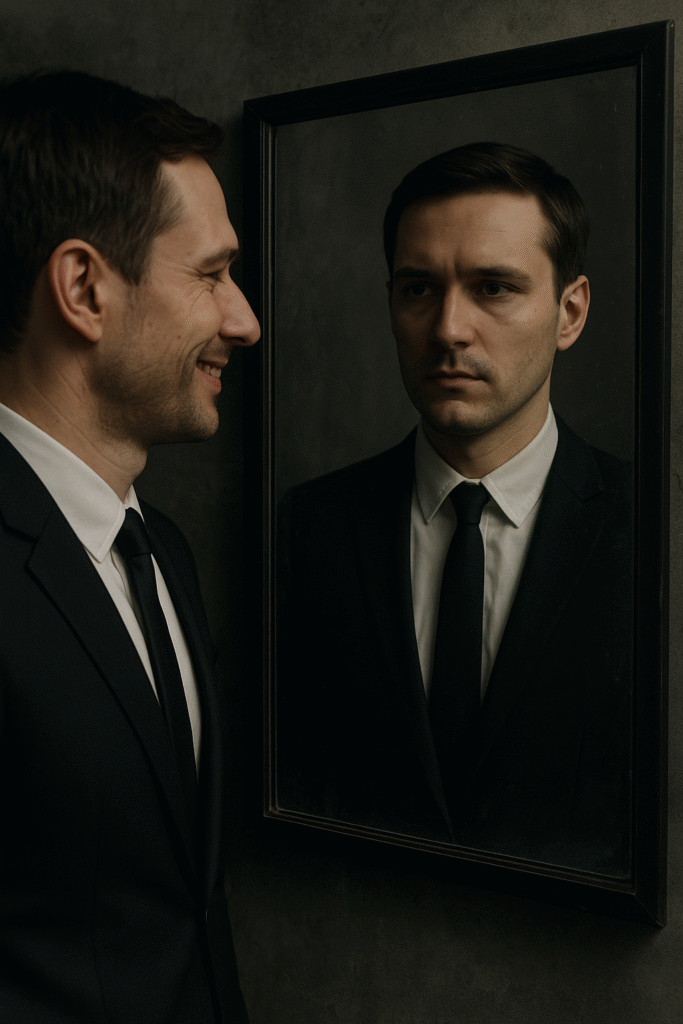
The Hollow One
They called him Daniel at the hospital, though he had no attachment to the name. It was printed on the band around his wrist, and so he answered to it when asked. People smiled when they spoke to him, sometimes even touched his hand, but none of it registered beyond the mechanics of recognition. He noticed their faces as he might notice wallpaper — present, patterned, irrelevant.
Daniel felt nothing. He never had.
As a child, he learned quickly to pretend. His mother would kneel by the bed, stroking his hair, waiting for him to smile when she did. He trained himself to copy her expression, to lift his lips, to widen his eyes. Later, he practised frowns in the mirror, rehearsed laughter until he could deploy it at the right cues. The world wanted echoes, so he became an echo.
He succeeded well enough to pass through school, through jobs, through relationships that burned out quickly once partners sensed the stillness behind his eyes. They said he was cold. They said he was cruel. But cruelty required intention, and Daniel had none. He was simply hollow.
At night, he often sat in front of the television, watching news footage of disasters — floods, fires, bodies carried out beneath sheets. He studied the faces of the grieving, the clenched jaws of reporters, the shaking hands of rescuers. He memorised the patterns of their pain, stored them for later use.
One evening, his neighbour knocked. Her cat had gone missing, and she stood in his doorway with tears streaking down her cheeks. Daniel tilted his head, imitating concern. He promised to keep an eye out.
The next day, when she came again, he told her he had seen the cat run into the road. She covered her mouth with both hands, trembling. He reached out — carefully, gently — and touched her arm, just as he had seen others do on television. She collapsed against him, sobbing into his chest.
And to his surprise, it worked.
She called him kind. She called him good. She told him she was grateful to have a neighbour like him.
The word lingered long after she left. Kind.
Daniel turned it over in his mind, like an artefact dug from the soil. He was not kind, not cruel, not anything. Yet she had believed it — because of the way he mirrored her grief. Because emptiness can reflect more perfectly than fullness.
From that day, he leaned further into the role. He listened, he nodded, he placed his hand where it would be noticed. People around him began to confide in him, drawn by the ease of their own reflection. They mistook his silence for wisdom, his lack of judgement for compassion.
He watched them weep and laugh, rage and rejoice, all in front of the glass surface he offered. He felt none of it, but they saw themselves more clearly when he was near. And so they called him friend. Some even called him love.
Late at night, standing before the mirror, he studied his own face. He tried on a smile. It fit perfectly. He tried sorrow; it fit even better. He realised, with a slow, deliberate certainty, that it didn’t matter what he was inside. The world did not want his truth. It wanted its own reflection.
And though he felt nothing, Daniel understood at last:
The hollow vessel is the one that fills the fastest.
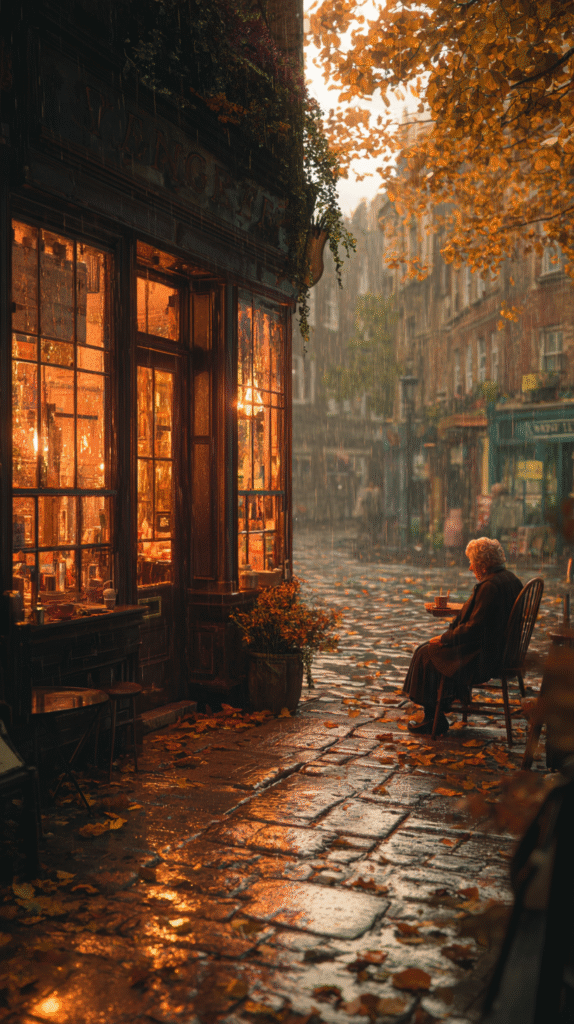
When It Rained in October
The rain had been falling since dawn — the kind of soft, persistent drizzle that Londoners had long stopped noticing, but which still made Mrs. Hollis pause by the window every morning. She liked to watch the raindrops slide down the glass, merge into little rivers, and race toward the sill. There was something reassuring in their predictability.
She wrapped her cardigan tighter and glanced at the clock. 10:07. Too early for lunch, too late for breakfast — the hour for coffee. Not just any coffee, but the one she made every autumn: strong, black, with a hint of cinnamon. The smell reminded her of him.
She shuffled to the small kitchen, slippers brushing the tiled floor. The kettle hissed, steam rising in graceful swirls. She opened the small tin where she kept the cinnamon — the same tin her husband had bought her on Portobello Road forty years ago, when they still went there on Saturdays, when he still teased her about spending too much money on “silly little spices.”
She smiled faintly, then stirred the powder into the mug. The scent filled the flat, rich and warm, wrapping around her like a scarf. She took her coffee to the window seat — her favourite spot — and watched the street below: umbrellas like dark petals opening and closing, the red blur of a passing bus, the wet gleam of pavement reflecting light.
The world looked both alive and far away.
On the opposite side of the street, the small café on the corner was open. Through the fogged window she could see people — mostly students with laptops, an old man reading the paper, a woman laughing into her phone. She used to go there. Before her knees began to ache, before the stairs felt like a hill. Now she just watched from her window, inventing stories for the strangers who came and went.
She sipped her coffee and thought, as she always did, that she should write them down. She used to write letters — long ones, full of unnecessary details. Her husband had teased her about that too, saying she could make a shopping list sound like poetry.
He had been gone for twelve years.
And yet some mornings, when the rain was soft like this, she still turned her head as if expecting to see him come through the door.
At half past ten, the post arrived — the usual stack of bills, catalogues, and charity envelopes. But today there was something different. A pale-blue envelope with her name written in an unfamiliar, slanted hand.
Her heart gave a small, startled flutter.
She sat down at the table, tracing the handwriting with her finger before opening it.
Inside was a short note, no return address:
Dear Mrs. Hollis,
I found something that might belong to you. I wasn’t sure where else to send it.
If you’d like to come by, I’ll be at the corner café today until four. — D.H.
Below the initials was a small photograph — slightly faded, black and white.
She caught her breath.
It was them.
Taken in 1965, on the same street, under a tree bursting with yellow leaves. She was smiling — really smiling — and he had his arm around her shoulders. Someone must have taken it without them noticing.
But how on earth had it ended up in someone else’s hands?
By eleven, she’d made up her mind.
She wasn’t a reckless woman anymore, but curiosity — and something warmer, something like the pulse of youth — stirred inside her. She changed her cardigan, added her wool coat, tied a scarf with clumsy fingers.
The air outside was crisp and smelled of wet leaves. The rain had eased into a mist. As she walked, she noticed small things she hadn’t in a long time — the way the puddles caught reflections of buildings, the rhythm of her steps against the pavement, the laughter of schoolchildren running past.
The café was busier than she remembered. The hum of conversation mixed with the hiss of the espresso machine and the scent of roasted beans. She ordered a cappuccino — with cinnamon, out of habit — and scanned the room.
Near the window sat a man, maybe in his fifties, tall, with grey at his temples and a tweed coat hung over his chair. He looked up when she approached, and his face lit with a small, nervous smile.
“Mrs. Hollis?”
“Yes,” she said softly. “And you must be—”
“Daniel. Daniel Hargreaves.”
He gestured for her to sit.
“I’m sorry for the strange note,” he said, “but I thought you’d want to have the photograph. My mother passed away last month, and while clearing her things I found a box of old pictures. This one had your name written on the back — in what I think was my father’s handwriting.”
She looked at him carefully. The name did ring a faint bell. “Your father’s handwriting?”
He nodded. “He was a photographer. Used to take candid street portraits in the ’60s. Sometimes he’d send prints to the people he captured if he knew their names. I suppose he must have met you and your husband.”
Mrs. Hollis stared down at the photo again, the memory slowly awakening.
“Yes,” she whispered. “He did. I remember now. It was the year we moved here. We’d just had an argument — something silly, about the colour of the curtains, I think. Then this man came up and asked to take our picture because he liked how we looked under the tree. We ended up laughing. The argument was gone by the time we got home.”
Daniel smiled. “He used to say photographs could fix moments that might otherwise fade. I think he was right.”
They sat in a comfortable quiet. The rain began again, tapping against the window. She took a sip of her coffee — too much foam, not enough cinnamon — but somehow perfect all the same.
When Daniel left, he gave her his card and said, almost shyly, “My father always wanted to hold a small exhibition of his early work. Maybe you’d like to come when I finally put it together.”
She promised she would.
Walking back home, she felt lighter. The city seemed a little brighter, the air tinged with that rich smell of roasted coffee and rain-soaked leaves.
At home, she placed the photograph on the mantelpiece, beside her husband’s old pocket watch. For the first time in years, the room felt less empty — as if the past had quietly folded itself into the present.
She sat down with her journal and began to write, not a letter this time, but a story. About rain and coffee and the kindness of strangers. About how time can scatter people like leaves, yet sometimes, by pure accident, it lets them find their way back — even for a moment.
Outside, the rain fell harder. She didn’t close the curtains. The streetlights came on, reflecting in the puddles like small, golden memories.
When she finished her coffee, she added just a pinch more cinnamon — not because it changed the taste, but because it felt like a way to remember.
The clock ticked softly. The photograph watched her from the mantel.
And for the first time in a long while, Mrs. Hollis whispered to the quiet room,
“It’s raining in October again, love. You’d have liked this one.”